
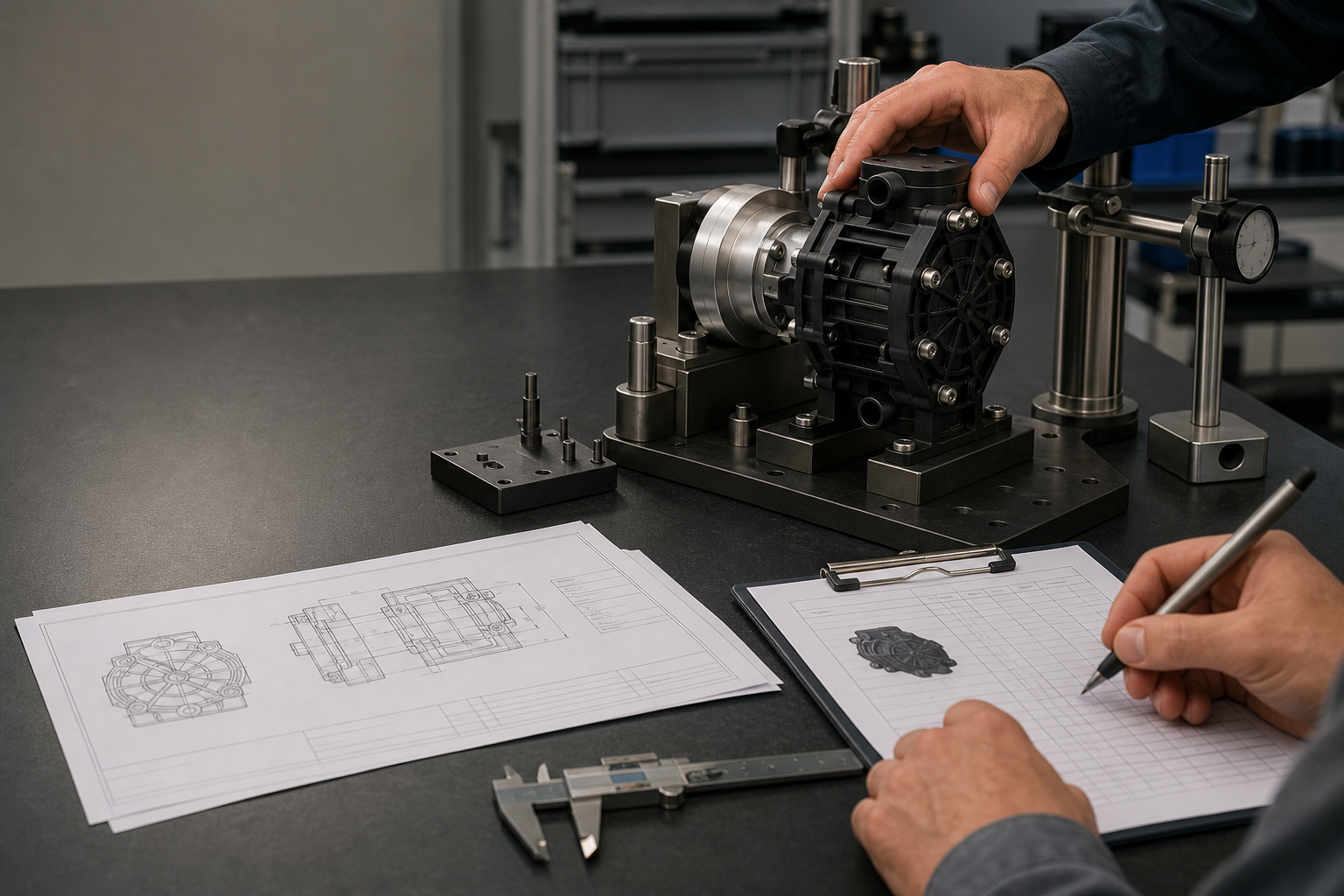
Treat the manufacturer as part of the product architecture
When an OEM team searches for a miniature pump manufacturer, the first comparison is often a table of flow, pressure, voltage and dimensions. Those fields matter, but they do not show whether the supplier can carry a design from an engineering question to a repeatable production configuration.
A supplier becomes part of the product architecture when its material choices, drawing revisions, test methods, production records and change notices affect the equipment release. The evaluation should therefore ask not only “which model fits?” but also “which evidence will remain available when the model, lot or process changes?”
Use a supplier scorecard before comparing quotations
Before requesting a formal quotation, score each miniature pump manufacturer on five separate dimensions: engineering response, configuration control, sample evidence, production readiness and change support. Keep these scores separate from unit price so a low quotation cannot hide a high integration or release risk.
A useful first-pass scorecard records the supplier's answer, the evidence attached to that answer and the remaining unknown. “Can support OEM customization” is a claim; a named engineering contact, revision-controlled drawing, sample report and documented change path are evidence. The scorecard should reward the latter.
Audit engineering response and document control
A strong micro air pump manufacturer or diaphragm liquid pump OEM should be able to restate the application in engineering terms before recommending a model. Look for a response that identifies the missing boundary conditions, separates confirmed data from assumptions and assigns an owner for the next decision.
Then review how documents are controlled. Each drawing, specification, material statement and sample report should identify the model, configuration, revision and issue date. Ask what happens when the document changes: who is notified, whether an old version remains blocked from production and how the change is linked to open customer projects.
This review is different from asking which CAD files are available. The question is whether the supplier's information stays consistent across quotation, sample, pilot build and production release.
Ask how prototypes become repeatable builds
A first sample proves that one unit was assembled. It does not prove that the same configuration will be built next month or at a different production quantity. During supplier review, ask the manufacturer to show the handoff from approved sample to production instruction, inspection point and lot record.
For a supplier of micro air pump or liquid pump assemblies, the useful evidence is not a generic factory photograph. It is a traceable link between the approved build, the assembly instructions, the inspection result and the person or station that released the lot.
If the supplier cannot explain this handoff, record it as an open production-readiness risk. Do not close the risk merely because the prototype met the initial equipment test.
Evaluate evidence without accepting unsupported claims
Supplier evidence should answer four questions: what was tested, in which configuration, under which condition and against which acceptance rule. A graph without a model revision, a pass statement without a test state or a material label without the affected parts is not enough for an OEM release decision.
Ask for a sample report that distinguishes measured values, nominal specifications and customer acceptance limits. Also ask how deviations are handled. A mature supplier can explain whether a deviation requires rework, engineering review, a concession or a new sample, instead of treating every result as an informal conversation.
Test the supplier's change communication before production
The supplier review should include a simple change scenario: a material source changes, a motor becomes unavailable, a port is revised or a test station is replaced. Ask what notification the customer receives, what documents are updated and whether a new approval decision is required.
This is especially important when comparing an established miniature pump manufacturer with a low-cost alternative. The relevant question is not whether either supplier has ever made the part; it is whether both suppliers can keep the approved configuration visible when conditions change.
Put the agreed change path into the purchase or quality record before the first production order. It is easier to negotiate notification and requalification rules before a change than after an affected lot has shipped.
Prepare an RFQ that reveals manufacturing capability
A useful OEM RFQ gives the supplier enough information to demonstrate its process, not only enough information to return a catalog model. Include the application, target function, electrical constraints, envelope, medium, duty profile, expected annual volume, required documents, sample quantity and acceptance evidence.
Ask each supplier to return the same response structure: recommended configuration, assumptions, exclusions, open questions, sample plan, production lead time and change-control contact. Consistent responses make supplier comparison more reliable and expose missing capability earlier.
The final choice should be based on the complete evidence package and the risk left after review. Price remains relevant, but it should be compared with the cost of another prototype cycle, a delayed release or an uncontrolled configuration change.
A practical 30-minute supplier review sequence
Start with the supplier's written response and mark every statement as confirmed, assumed or open. Next, choose one sample record and trace it backward to the configuration and forward to the production or inspection record. Then run one change scenario and check whether the notification and reapproval path is clear.
If those three checks are clear, continue with the detailed product and application review. If they are not, the supplier may still be technically capable, but the OEM team should record the evidence gap before awarding the program.
The best miniature pump manufacturer is not necessarily the one with the longest catalog or lowest first quotation. It is the supplier that can make the approved configuration understandable, testable, repeatable and supportable throughout the equipment lifecycle.
Frequently asked questions
How should two miniature pump manufacturers be compared when their catalog specifications are similar?
Compare the evidence and process around the specification: response quality, revision control, sample-to-production handoff, lot records and change communication. Similar catalog numbers do not prove similar supply risk.
Should an OEM audit a pump supplier before ordering samples?
A full on-site audit may not be necessary at the first contact, but a document and response review is worthwhile before sampling. It can reveal missing configuration data, unclear ownership or unsupported claims early.
What should be included in a miniature pump supplier scorecard?
Include engineering response, configuration and document control, sample evidence, production readiness, traceability, change notification, lead time and the open risks that still need customer approval.
Related products and engineering resources
Continue with the products, application material and engineering support related to this topic, or submit project conditions for a selection review.